

Strategic Value
Build compounding credibility and attract qualified prospects through documented expertise
Before you start
What you'll find in this guide
Event writeups transform live experiences into enduring knowledge assets that build credibility, attract talent, and strengthen your startup community. These comprehensive post-event summaries blend narrative, takeaways, speaker insights, and resources to create valuable content for founders, investors, and community members.
Strategic Value
Build compounding credibility and attract qualified prospects through documented expertise
Knowledge Preservation
Capture frameworks, benchmarks, and playbooks discussed by operators and founders
Content Repurposing
One event fuels newsletter posts, social content, slides, and internal resources
Compounding Credibility
Public Track Record: Well-documented events become evidence of learning, traction, and thought leadership
Investor Updates: Clean links for monthly/quarterly updates showing founder-market fit exploration
Qualified Lead Generation
Search Traffic: Good writeups capture organic traffic and convert via strategic CTAs
Top-of-Funnel: Attracts subscribers, applicants, and office hours bookings
Talent Attraction
Culture Signal: Candidates assess your velocity and craft through event documentation
Team Building: Shows expertise areas and community engagement quality
Content Multiplication
Repurposing Engine: One event creates newsletter content, LinkedIn threads, slide decks
Knowledge Base: Builds searchable library of frameworks and learnings
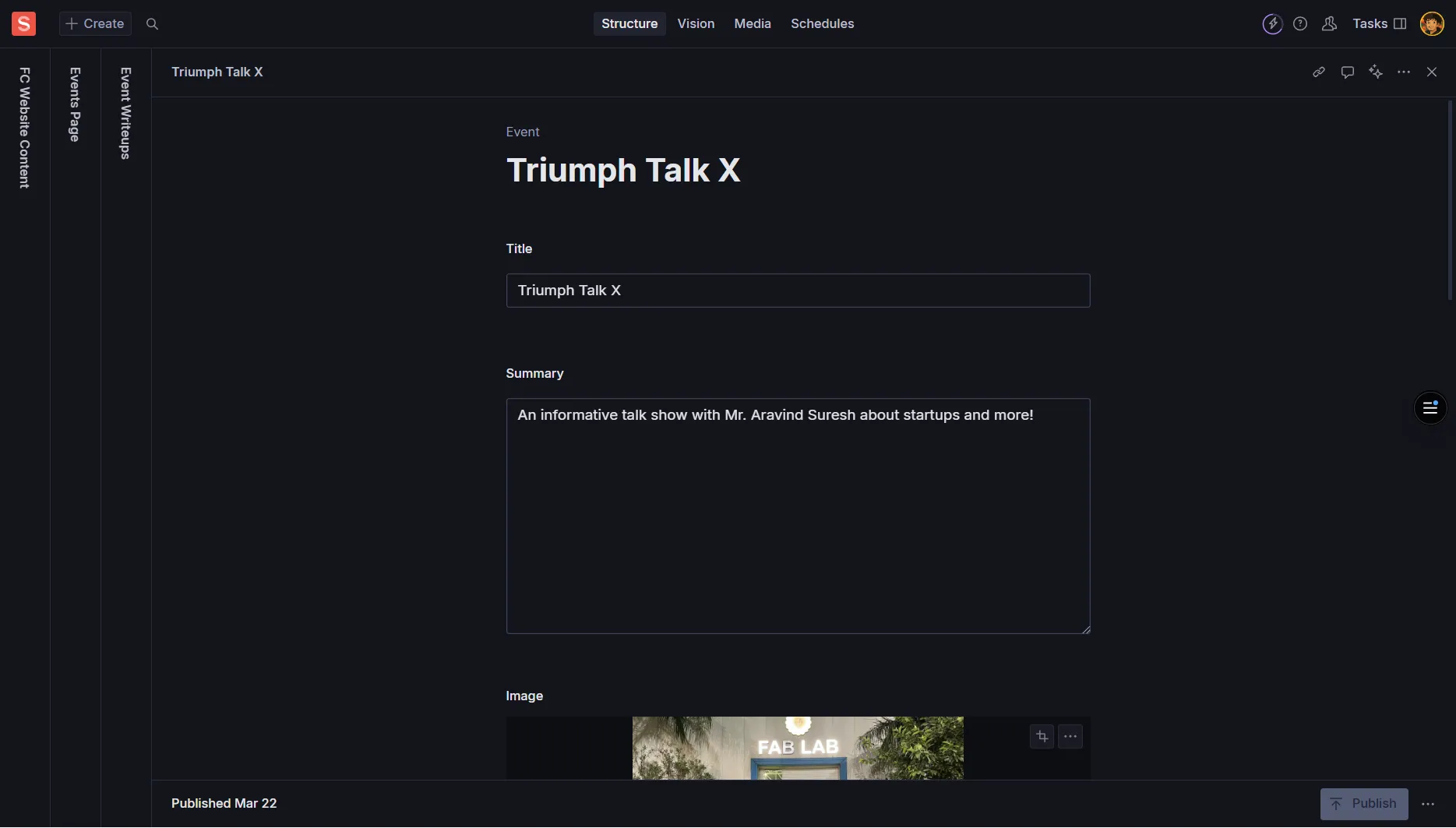
Title
Required - Clear and outcome-focused
Better: “Finding PMF in Fintech: Frameworks from Seed to Series A”
Avoid: “Monthly Startup Meetup #12”
Lead with the outcome or framework rather than generic labels
Slug
Required - URL-friendly identifier
Auto-generated from title in most cases
Example: “pmf-fintech-frameworks-seed-series-a”
Date & Time
Required - Event date and time
Use consistent timezone (local or UTC)
Format: YYYY-MM-DD HH:MM
Powers URL structure and canonical metadata
Location
Optional - Event venue or format
Examples: “Mumbai, WeWork”, “Online”, “Hybrid - Bangalore Hub”
Be specific and consistent with location formatting
Event Type
Optional - Format classification
Options: panel, workshop, fireside, demo-day, AMA, office-hours, hackathon, pitch-practice, meetup
Helps with filtering and content organization
Audience
Optional - Target participant groups
Array: Founders, Investors, Students, Operators, Designers, Engineers
Multiple selections allowed for cross-functional events
Startup Stage
Optional - Focus stage for content
Options: idea, pre-seed, seed, series-a, growth
Helps readers find stage-appropriate content
Host/Organizers
Optional - Event organizers
Array of names, teams, or organizations
Can reference team member profiles if available
Cover Image
Optional - Hero image for the event
Landscape format recommended
Always add descriptive Alt Text
Example Alt Text: “Panel discussion with 4 founders at Founders Club event”
Hero Video URL
Optional - Recording or livestream link
YouTube, Vimeo, or CDN URLs
Takes priority over cover image in some themes
Include captions/subtitles for accessibility
Summary/Excerpt
Optional - Brief overview (150-200 characters)
1-2 sentences focused on audience and value
Used in listings, social cards, and SEO
Example: “Learn 3 frameworks for B2B SaaS pricing from founders who raised $50M+“
Each speaker entry includes:
Basic Information
Name (required) - Full name
Role (optional) - Job title
Organization (optional) - Company or affiliation
Example: “Priya Sharma, CEO, TechStart Solutions”
Bio and Image
Bio (optional) - Short professional summary
Headshot (optional) - Professional photo with Alt Text
Portrait or square format preferred
Alt Text example: “Portrait of John Doe, CTO at StartupCorp”
Social Links
Array of social media and professional profiles
Label - Platform name (LinkedIn, Twitter, Website)
URL - Full URL starting with https://
Quality over quantity - 2-3 relevant links
Time Slots
Time - Time range for each segment
Format: “18:30–19:00” or “6:30-7:00 PM”
Be consistent with time formatting
Agenda Items
Title - Name of the session or segment
Examples: “Welcome & Intros”, “Panel: PMF Strategies”, “Q&A Session”
Speaker Assignment
Speaker(s) - Who’s leading each segment
Format: “Jane Doe (Acme, CEO)” or reference to speaker profiles
Can list multiple speakers for panels
Writeup/Body
Required - Rich text content with full event narrative
Use headings (H2/H3), lists, quotes, and embeds
Structure for scannability with clear sections
Include context, highlights, deep dives, and case examples
Key Takeaways
Recommended - 3-7 actionable bullet points
Write “so what” bullets with verbs and specificity
Example: “Shift onboarding goal to first value within 10 minutes; measure activation rate”
Focus on frameworks and actionable insights
Quotes/Testimonials
Optional - Impactful quotes from speakers or attendees
Quote - The testimonial text
Author - Person’s name
Role/Company - Their title and organization
Resources & Links
Optional - Downloadable and reference materials
Label - Descriptive link text (“Download Slides”, “Framework Doc”)
URL - Full https:// links
Examples: Slides, templates, GitHub repos, reading lists
Event Metrics
Optional - Measurable outcomes and attendance data
Label - Metric name (“Attendees”, “Demos”, “Signups”)
Value - Numerical result
Focus on substance over vanity metrics
Example: “126 attendees, 18 live demos, 42 newsletter signups”
Problem/Solution Framing
Customer Jobs: What painful customer jobs were discussed?
Solution Mapping: Which solutions mapped cleanly to real demand?
Demand Signals: How to distinguish real demand from feature requests
Product-Market Fit (PMF)
Metrics: Activation, retention, frequency benchmarks by segment
Qualitative Cues: Inbound pull, pricing power, referral loops
Signal Detection: Early indicators and measurement frameworks
Go-to-Market (GTM)
Channel Strategy: Zero-to-one channels that worked, first scalable channel
Sales Learnings: Cold outreach scripts, founder-led sales insights
Growth Loops: Community-led growth and referral mechanisms
Pricing & Monetization
Experiments: Monetization tests and willingness-to-pay insights
Packaging: Pricing structure decisions and discounting policies
Value Mapping: How pricing connects to customer value delivered
Opening Context
Audience & Goal: Who attended and why it matters now
Problem Setup: What challenges or opportunities were addressed
Stakes: Why this topic is critical for the target audience
Main Content Flow
Highlights: 3-5 bullets on most actionable insights
Deep Dives: Short sections per theme (PMF, GTM, fundraising)
Case Examples: Snapshots from speakers or attendee stories
Frameworks: Repeatable processes and decision tools shared
Resource Integration
Downloads: Links to slides, templates, checklists
References: Books, articles, tools mentioned
Community: Ways to continue the conversation
Call to Action
Next Steps: Clear action for readers to take
Community Building: Newsletter signup, upcoming events
Business Development: Applications, consultations, partnerships
Example Key Takeaways
Event Photos
Array of event images with captions
Alt Text - Describe what each image shows
Example: “Networking session with 20+ founders during coffee break”
Captions - Optional context or quotes
Keep file sizes reasonable for web loading
Image Specifications
Cover Images: Landscape format, 1600px+ width
Speaker Headshots: Portrait or square, 800px+ minimum
Gallery Photos: Consistent editing style, web-optimized
Alt Text: Always required for accessibility
Hero Videos
Recording Links: YouTube, Vimeo, or CDN URLs
Accessibility: Include captions/subtitles when possible
Fallback: Provide summary section for video content
Quality: Ensure good audio quality for professional presentation
CTA Configuration
Label - Action-oriented text
Examples: “Apply to Founder Program”, “Subscribe to Updates”, “Book Office Hours”
Type - Internal or external link
URL - Page reference or full https:// URL
Style - primary, secondary, outline for visual hierarchy
Business Alignment
Community Building: Newsletter signups, event notifications
Lead Generation: Program applications, consultation bookings
Engagement: Follow-up surveys, feedback collection
Partnership: Collaboration inquiries, speaking opportunities
Before Publishing
What makes a better event title?
What's the ideal length for a summary/excerpt?
How many key takeaways should you include?
What type of metrics should you prioritize?
What should key takeaways focus on?
Image Accessibility
Alt Text: Describe what images show, not just “event photo”
Example: “Panel with 4 founders discussing pricing strategies”
Contrast: Ensure text over images is readable with overlays if needed
Link Accessibility
Descriptive Labels: Use meaningful text (“Download slides” not “click here”)
URL Validation: Test all external links for functionality
Context: Provide context for where links lead
Content Quality
Outcome Focus: Lead with frameworks and actionable insights
Specificity: Include concrete examples, metrics, and benchmarks
Scannability: Use headings, bullets, and quotes for easy reading
Professional Presentation
Consistency: Maintain professional tone and formatting standards
Attribution: Properly credit speakers, quotes, and resources
Accuracy: Verify all facts, figures, and attributions before publishing
What did you learn?